
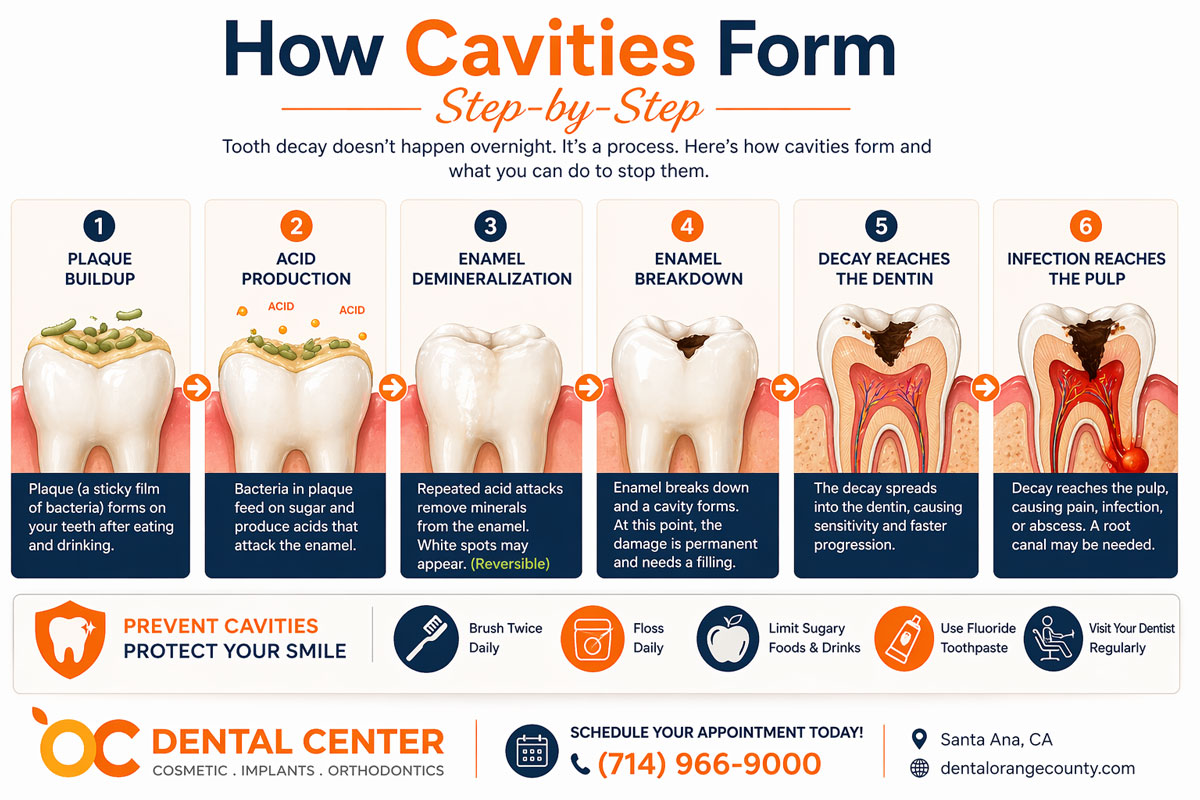
How Cavities Form (Step-by-Step)
Cavities are one of the most common dental problems, yet many patients don’t fully understand how they develop. Tooth decay doesn’t happen overnight—it’s a gradual process that starts with bacteria and can eventually lead to significant damage if left untreated.
At OC Dental Center in Santa Ana, we believe that understanding how cavities form can help you prevent them. In this guide, we’ll walk you through the step-by-step process of tooth decay and how to stop it early.
What Is a Cavity?
A cavity is a permanently damaged area in the tooth’s enamel that develops into a small hole. It is caused by a combination of bacteria, food, and acid that gradually break down the tooth structure [1].
Without treatment, cavities can progress deeper into the tooth, leading to pain, infection, and the need for more complex procedures.
Step 1: Plaque Buildup
The process begins with plaque—a sticky film of bacteria that forms on your teeth after eating and drinking.
- Bacteria feed on sugars and carbohydrates
- Plaque accumulates if not removed by brushing and flossing
If plaque is not cleaned away regularly, it becomes the starting point for tooth decay.
Step 2: Acid Production
When bacteria in plaque consume sugars, they produce acids as a byproduct. These acids begin to attack the tooth’s enamel.
This process is often referred to as an “acid attack,” which can last for 20–30 minutes after eating [2].
Common Triggers
- Sugary snacks and drinks
- Frequent snacking
- Acidic beverages like soda
Step 3: Enamel Demineralization
Repeated acid attacks weaken the enamel through a process called demineralization. At this stage:
- Minerals are lost from the enamel
- White spots may appear on the tooth surface
This is the earliest stage of tooth decay—and it is often reversible with proper care.
Step 4: Enamel Breakdown (Cavity Formation)
If demineralization continues, the enamel begins to break down, forming a cavity.
- Permanent damage to the tooth structure
- Requires a filling to restore the tooth
At this point, the damage cannot heal on its own and must be treated by a dentist.
Ready for a confident, healthy smile?
Located in Santa Ana California
Step 5: Decay Reaches the Dentin
Once the cavity penetrates the enamel, it reaches the dentin—the softer layer beneath. Decay spreads more quickly at this stage.
- Increased sensitivity
- Faster progression of decay
Treatment becomes more urgent to prevent further damage.
Step 6: Infection Reaches the Pulp
If untreated, decay can reach the pulp, the innermost part of the tooth containing nerves and blood vessels.
- Severe tooth pain
- Infection or abscess
- Possible need for a root canal
At this stage, treatment is more complex and may require endodontic therapy.
Can Cavities Be Reversed?
Early-stage decay (demineralization) can sometimes be reversed with:
- Fluoride treatments
- Improved oral hygiene
- Dietary changes
Once a cavity forms, however, it requires professional treatment.
How to Prevent Cavities
Preventing cavities starts with consistent daily habits:
- Brush twice daily with fluoride toothpaste
- Floss daily to remove plaque between teeth
- Limit sugary and acidic foods
- Visit your dentist regularly for cleanings and exams
Preventive care is the most effective way to avoid tooth decay.
Why Early Detection Matters
Catching cavities early allows for simpler, less invasive treatment. Small cavities can be treated with fillings, while advanced decay may require crowns or root canals [3].
Regular dental exams and X-rays play a critical role in early detection.
When to See a Dentist in Santa Ana
If you notice sensitivity, tooth pain, or visible spots on your teeth, it’s important to schedule a dental evaluation.
At OC Dental Center, we use advanced diagnostic tools to detect cavities early and provide effective treatment.
Final Thoughts
Cavities develop over time, but they are largely preventable. By understanding the step-by-step process of tooth decay, you can take proactive steps to protect your teeth and maintain a healthy smile.
If you’re concerned about cavities or due for a checkup in Santa Ana, our team is here to help you stay ahead of dental problems.
References
- American Dental Association. “Tooth Decay: Causes and Prevention.”
- National Institute of Dental and Craniofacial Research. “Dental Caries Process.”
- Cleveland Clinic. “Cavities Overview.”
- NHS. “Tooth Decay Explained.”

AUTHOR BIO: Dr. Pooneh Sabo D.D.S
Dr. Pooneh Sabo is a comprehensive cosmetic and functional dentist and founder of OC Dental Center in Orange County, California. With over two decades of clinical experience, she specializes in oral care ingredient safety, cosmetic dentistry, whitening technologies, and minimally invasive treatment focused on preserving natural tooth structure and long-term oral health.