
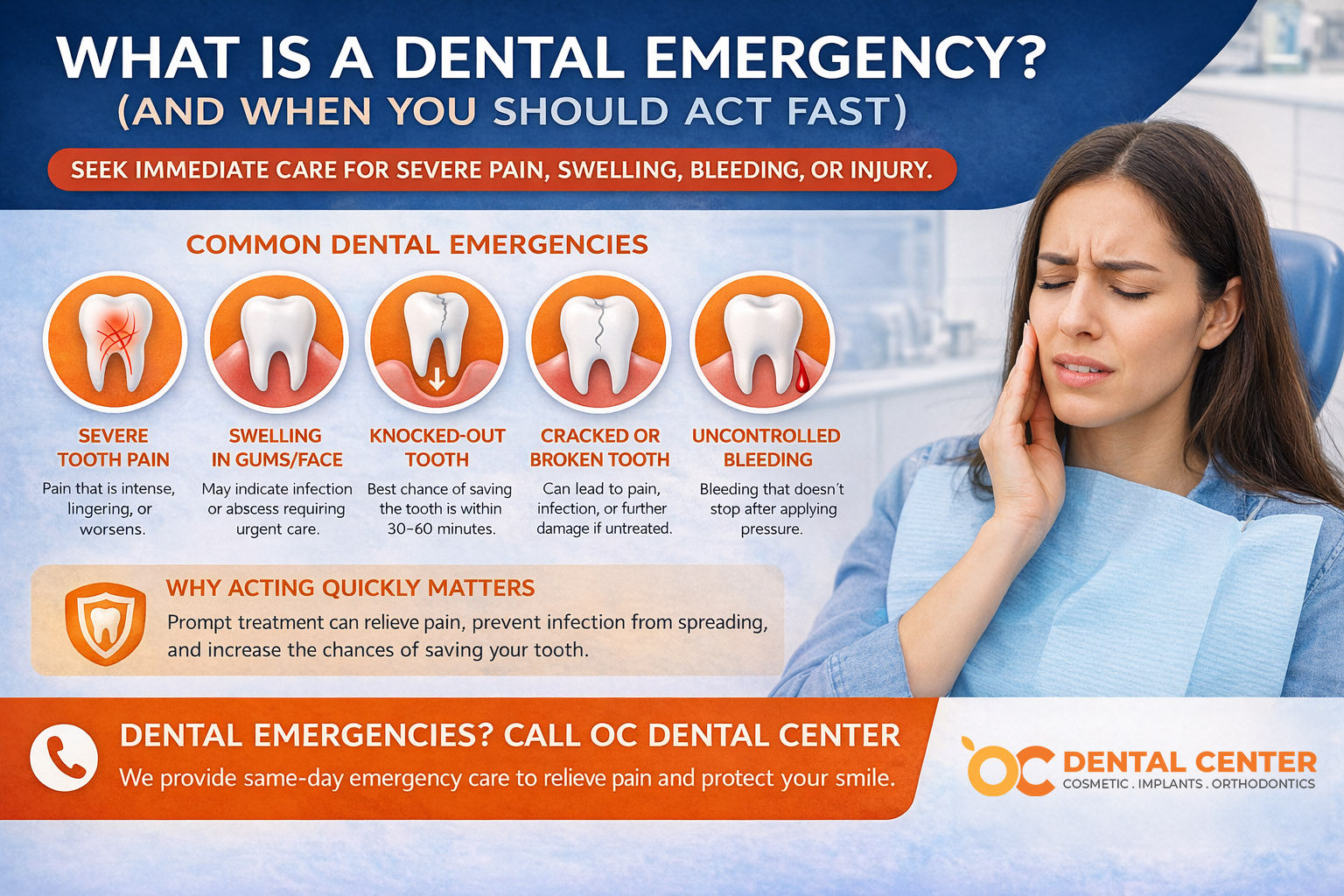
What Is a Dental Emergency? (And When You Should Act Fast)
Dental problems don’t always happen at convenient times. A sudden toothache, broken tooth, or swelling can be stressful and painful—but not every dental issue is considered an emergency.
Understanding what qualifies as a dental emergency can help you make the right decision and get care when it matters most.
What is a dental emergency?
A dental emergency is any condition involving the teeth, gums, or surrounding tissues that requires immediate attention to relieve severe pain, stop bleeding, or prevent infection from spreading.1
Some dental issues can wait a few days, but others require same-day treatment to avoid more serious complications.
Common dental emergencies
Severe tooth pain
Persistent or intense tooth pain may indicate infection, deep decay, or nerve involvement. Pain that lingers or worsens with pressure can be a sign of pulpal inflammation or infection.2
Swelling in the gums or face
Swelling, especially when accompanied by pain or fever, may indicate a dental abscess. Untreated odontogenic infections can spread to surrounding tissues and require urgent care.3
Knocked-out tooth
An avulsed (knocked-out) tooth requires immediate attention. Replantation within 30 to 60 minutes significantly improves the chances of saving the tooth.4
Cracked, broken, or fractured tooth
Tooth fractures can expose dentin or pulp, increasing the risk of pain and infection. Early evaluation helps determine whether the tooth can be preserved.2
Uncontrolled bleeding
Bleeding that does not stop with pressure may indicate trauma or soft tissue injury and should be treated promptly.1
Ready for a confident, healthy smile?
Located in Santa Ana California
Dental issues that may not be emergencies
Not all dental concerns require immediate care. Some issues can usually wait for a scheduled appointment, including:
- Mild tooth sensitivity
- Small chips without pain
- Lost fillings or crowns without discomfort
- Food stuck between teeth
However, even these issues should still be evaluated to prevent them from becoming more serious over time.
What to do in a dental emergency
If you experience a dental emergency, taking the right steps can make a difference:
- Tooth knocked out: Keep it moist (in milk or saliva) and seek care immediately
- Swelling: Apply a cold compress and contact your dentist
- Bleeding: Apply firm pressure with clean gauze
- Pain: Avoid chewing on the affected side and seek evaluation
Prompt treatment can often save a tooth and prevent complications.
Why acting quickly matters
Delaying care in an emergency situation can lead to worsening pain, infection, and more extensive treatment. Infections of dental origin can spread to facial spaces and, in rare cases, become life-threatening if untreated.3
What this means for patients at OC Dental Center of Santa Ana
At OC Dental Center of Santa Ana, emergency dental care focuses on relieving pain, stabilizing the problem, and protecting long-term oral health. Dr. Pooneh Sabo provides prompt evaluation and treatment to address urgent dental concerns.
If you are experiencing severe pain, swelling, or dental trauma, it is important to seek care as soon as possible to prevent further complications.
References
- American Dental Association. Dental Emergency Guidelines. Accessed March 2026.
- Abbott PV. Diagnosis and management of cracked teeth. Australian Dental Journal. 2009.
- Robertson D, Smith AJ. The microbiology of the acute dental abscess. Journal of Medical Microbiology. 2009.
- Andersson L et al. Guidelines for the management of traumatic dental injuries. International Association of Dental Traumatology. 2020.

AUTHOR BIO: Dr. Pooneh Sabo D.D.S
Dr. Pooneh Sabo is a comprehensive cosmetic and functional dentist and founder of OC Dental Center in Orange County, California. With over two decades of clinical experience, she specializes in oral care ingredient safety, cosmetic dentistry, whitening technologies, and minimally invasive treatment focused on preserving natural tooth structure and long-term oral health.
