
Signs You May Need a Dental Crown
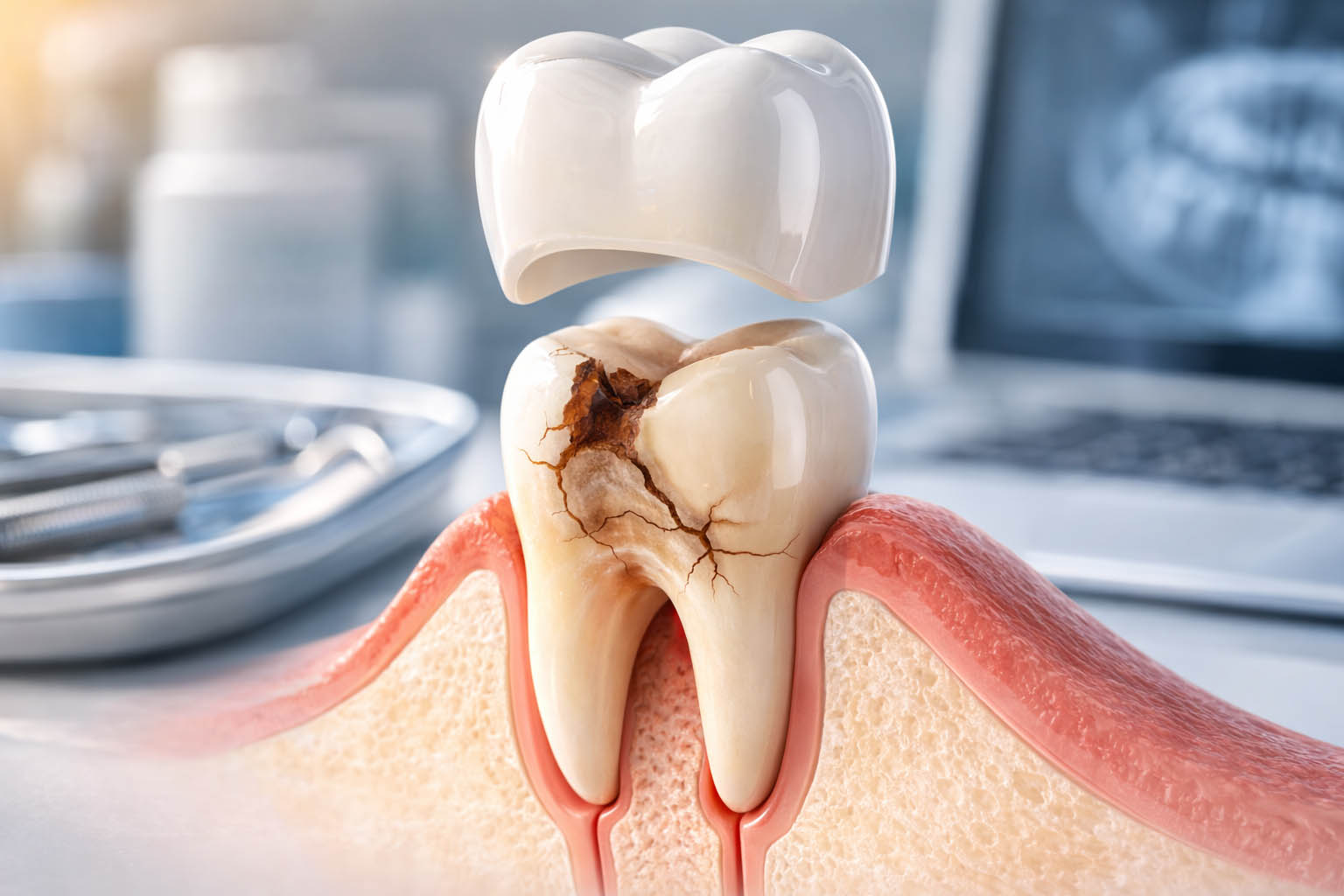
Not every damaged tooth needs a crown, but there are times when a filling may no longer provide enough support. A dental crown is a custom restoration that covers the visible part of a tooth to help restore its strength, function, and appearance.1,2
Because a crown fits over the tooth like a protective cap, it is often recommended when a tooth has been weakened, broken, heavily filled, or worn down over time.1,2,3 The goal is not just to repair damage, but to help prevent the tooth from breaking further.
1. You have a large filling and not much natural tooth left
One of the most common reasons for a crown is that a tooth has a very large filling and not enough remaining natural structure to stay strong long term. When too much of the original tooth is missing, the tooth may be more likely to crack under normal chewing pressure.1,2
2. Your tooth is cracked, fractured, or breaking down
If a tooth has a visible crack, a fractured cusp, or has already lost a piece of structure, a crown may be recommended to help hold the tooth together and protect it from additional damage.1,3,4 In many cases, this is especially important for back teeth because they absorb greater chewing forces.4
3. The tooth hurts when you bite down
Pain when chewing or biting can sometimes be a sign that a tooth is cracked or structurally compromised. While bite pain can have different causes, one possible reason is that the tooth is flexing under pressure because it no longer has enough strength. If that is the case, a crown may be part of the treatment plan after the tooth is properly evaluated.
4. Your tooth is severely worn down
Grinding, clenching, acid erosion, and long-term wear can gradually shorten and weaken teeth. In some situations, a crown may be recommended to rebuild the tooth’s shape and help restore function.1,2
5. You had a root canal on a back tooth
Many patients ask whether they need a crown after root canal treatment. According to the American Association of Endodontists, molars and premolars often do need crowns after root canal therapy because those teeth handle more chewing force, while front teeth do not always require one.4
This does not mean every root canal-treated tooth automatically needs a crown, but it is a common recommendation when the tooth is weakened or located in an area that takes heavy function.1,4
Ready for a confident, healthy smile?
Located in Santa Ana California
6. The tooth has a cavity that is too large for a filling
Small and moderate cavities are often treated with fillings. But when a cavity is too large, a filling may not provide enough coverage or long-term support. In these cases, a crown may be the more predictable way to restore and protect the tooth.1,5
7. An old filling keeps failing or the tooth keeps chipping
If a tooth has had multiple repairs over time, or if old restorations keep breaking down, a crown may be recommended as a more complete protective solution. This is often the case when repeated patchwork repairs no longer leave enough strong tooth structure behind.2
8. The tooth needs both strength and cosmetic improvement
Crowns are sometimes used when a tooth is damaged and also needs major cosmetic improvement. This may apply to severely discolored, misshapen, or structurally compromised teeth when simpler cosmetic options are not enough.1,2,3
What a crown can and cannot do
A crown can help protect a weakened tooth, restore chewing function, and improve appearance. But it also requires reshaping the tooth so the restoration can fit properly.1,3 That is why dentists do not place crowns on teeth unless there is a clear reason to do so.
In some cases, a more conservative option such as a filling, inlay, onlay, or bonding may be considered instead. The right choice depends on how much healthy tooth structure remains and how much force that tooth must handle.5
When to schedule an evaluation
You should have a tooth checked if you have a cracked tooth, pain on biting, a large broken filling, repeated chipping, or a root canal-treated back tooth that has not yet been permanently restored. Early evaluation can sometimes prevent a small structural issue from turning into a larger fracture.
What this means for patients at OC Dental Center of Santa Ana
At OC Dental Center of Santa Ana, the decision to recommend a crown is based on how much healthy tooth structure remains, where the tooth is located, how much force it handles, and whether a more conservative treatment can still predictably protect it. The goal is to restore strength while preserving as much healthy tooth as possible.
References
- Cleveland Clinic. Dental Crowns: Types, Procedure & Care. Accessed March 11, 2026.
- Leeds Teaching Hospitals NHS Trust. Crowns. Accessed March 11, 2026.
- NHS. Dental treatments. Accessed March 11, 2026.
- American Association of Endodontists. Root Canal Explained. Accessed March 11, 2026.
- Cleveland Clinic. Restorative Dentistry: What It Is, Types & Procedures. Accessed March 11, 2026.

AUTHOR BIO: Dr. Pooneh Sabo D.D.S
Dr. Pooneh Sabo is a comprehensive cosmetic and functional dentist and founder of OC Dental Center in Orange County, California. With over two decades of clinical experience, she specializes in oral care ingredient safety, cosmetic dentistry, whitening technologies, and minimally invasive treatment focused on preserving natural tooth structure and long-term oral health.
